Το Hin Sam Wan, γνωστό διεθνώς ως Three Whale Rock, είναι ένας εντυπωσιακός φυσικός σχηματισμός στη βορειοανατολική Ταϊλάνδη, που πήρε το όνομά του από την εντυπωσιακή ομοιότητά του με μια οικογένεια φαλαινών που μοιάζουν να «κολυμπούν» μέσα στο δάσος.
Ο σχηματισμός αποτελείται από τρεις τεράστιους, επιμήκεις και στρογγυλεμένους βράχους, οι οποίοι υψώνονται πάνω από την πυκνή βλάστηση της περιοχής, δημιουργώντας την ψευδαίσθηση γιγάντιων κητωδών που επιπλέουν σε μια πράσινη «θάλασσα».
Ο σχηματισμός δημιουργήθηκε πριν από περίπου 75 εκατομμύρια χρόνια, ως αποτέλεσμα μακροχρόνιας διάβρωσης και τεκτονικής ανύψωσης. Ο άνεμος και η βροχή διαμόρφωσαν σταδιακά τον ψαμμίτη στη βορειοανατολική Ταϊλάνδη, λειαίνοντας τις επιφάνειες και δημιουργώντας ρωγμές που συνέβαλαν στο να πάρουν οι βράχοι τη στενή, επιμήκη μορφή που σήμερα θυμίζει φάλαινες.
Το Three Whale Rock βρίσκεται κοντά στα σύνορα της Ταϊλάνδης με το Λάος, μέσα σε μια δασώδη προστατευόμενη περιοχή με την ονομασία Phu Sing Forest Park. Ένα δίκτυο μονοπατιών πεζοπορίας οδηγεί στους τρεις βράχους, ωστόσο μόνο οι δύο μεγαλύτεροι —η «μαμά» και ο «μπαμπάς»— είναι προσβάσιμοι στο κοινό. Ο μικρότερος βράχος, το «μωρό», παραμένει κλειστός για επισκέπτες.
Σύμφωνα με το National Geographic, η θέα από τις «ράχες» των δύο μεγαλύτερων πέτρινων φαλαινών εκτείνεται μέχρι τον ποταμό Μεκόνγκ και τα βουνά της περιοχής Pakkading στο Λάος. Οι βράχοι βρίσκονται σε μια ψηλή ράχη και προεξέχουν πάνω από την κόμη του δάσους, ενισχύοντας την ψευδαίσθηση ότι πρόκειται για θαλάσσια πλάσματα στο φυσικό τους περιβάλλον.
Το Three Whale Rock και η γύρω περιοχή αποτελούν τμήμα του υψιπέδου Khorat, μιας ζώνης ανυψωμένων ιζηματογενών πετρωμάτων που έχει δώσει σημαντικά απολιθώματα. Στην περιοχή έχουν εντοπιστεί ίχνη ζωής από την Κρητιδική περίοδο (145 έως 66 εκατομμύρια χρόνια πριν), καθώς και από την Καινοζωική εποχή, η οποία εκτείνεται από πριν 66 εκατομμύρια χρόνια έως σήμερα.
Το Phu Sing Forest Park και οι χαρακτηριστικοί του βραχώδεις σχηματισμοί προστατεύονται ως περιοχές φυσικής και πολιτιστικής κληρονομιάς, αποτελώντας ένα από τα πιο ιδιαίτερα γεωλογικά και τοπιακά αξιοθέατα της βορειοανατολικής Ταϊλάνδης.
How the Three Impressive Stone Whales of Thailand Were Formed – They Seem to Swim Within the Forest
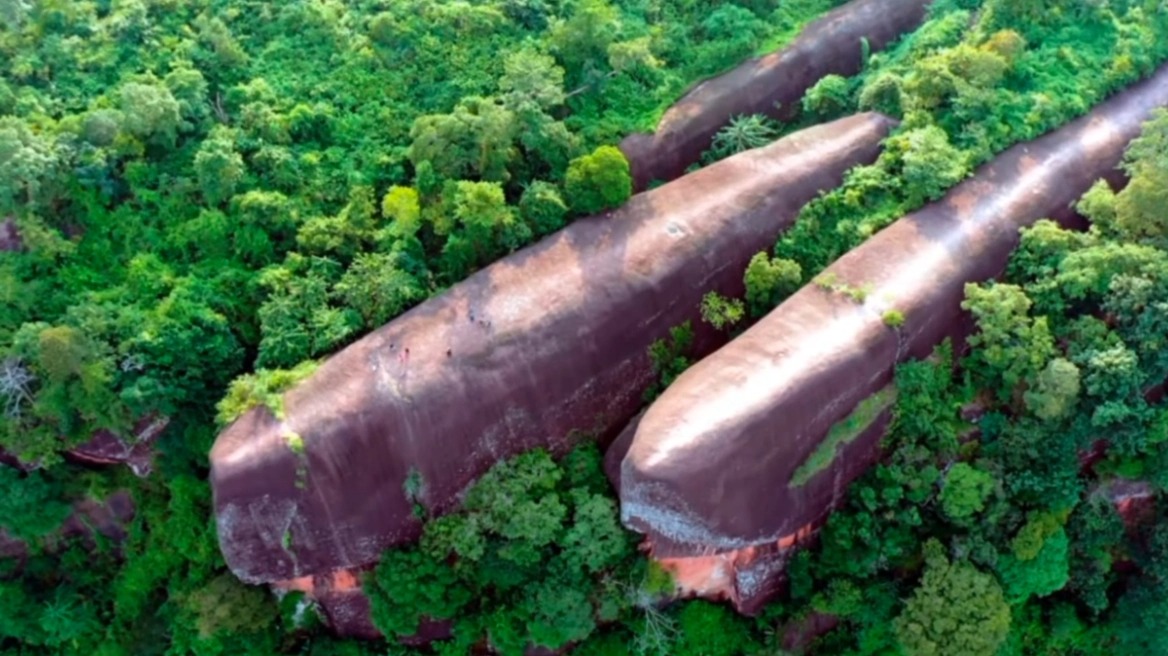
Hin Sam Wan, internationally known as Three Whale Rock, is an impressive natural formation in northeastern Thailand, named for its striking resemblance to a family of whales seemingly 'swimming' within the forest. The formation consists of three huge, elongated, and rounded rocks that rise above the dense vegetation of the area, creating the illusion of giant cetaceans floating in a green 'sea'. The formation was created about 75 million years ago, as a result of long-term erosion and tectonic uplift. Wind and rain gradually shaped the sandstone in northeastern Thailand, smoothing the surfaces and creating cracks that contributed to the rocks taking on the slender, elongated shape that today resembles whales. Three Whale Rock is located near the border of Thailand with Laos, within a forested protected area called Phu Sing Forest Park. A network of hiking trails leads to the three rocks, however only the two largest —the 'mother' and the 'father'— are accessible to the public. The smallest rock, the 'baby', remains closed to visitors. According to National Geographic, the view from the 'backs' of the two larger stone whales extends to the Mekong River and the mountains of the Pakkading region in Laos. The rocks are located on a high ridge and protrude above the forest canopy, enhancing the illusion that they are marine creatures in their natural environment. Three Whale Rock and the surrounding area are part of the Khorat Plateau, a zone of elevated sedimentary rocks that has yielded significant fossils. Traces of life from the Cretaceous period (145 to 66 million years ago), as well as from the Cenozoic era, which extends from before 66 million years ago to the present, have been identified in the area. Phu Sing Forest Park and its characteristic rocky formations are protected as areas of natural and cultural heritage, constituting one of the most remarkable geological and landscape attractions in northeastern Thailand.
You Might Also Like

Οι τρεις κορυφαίοι υποψήφιοι προορισμοί για τον Αντετοκούνμπο
Jan 29
Τρία φεγγάρια φώτισαν τη Μόσχα – Το σπάνιο φαινόμενο της παρασελήνης
Feb 1

Τραγωδία με οικογένεια στην Ιταλία: Από διαρροή αερίου στο σπίτι τους χάθηκαν γονείς και δύο παιδιά – Κάλεσε βοήθεια ο γιος, πριν λιποθυμήσει
Feb 5
Τραγωδία στις ΗΠΑ: Τέσσερις νεκροί από δηλητηριώδη μανιτάρια στην Καλιφόρνια
Feb 7

Επεισόδια στο Μιλάνο κοντά στο Ολυμπιακό Χωριό: Κροτίδες και δακρυγόνα μεταξύ αστυνομίας και διαδηλωτών
Feb 7